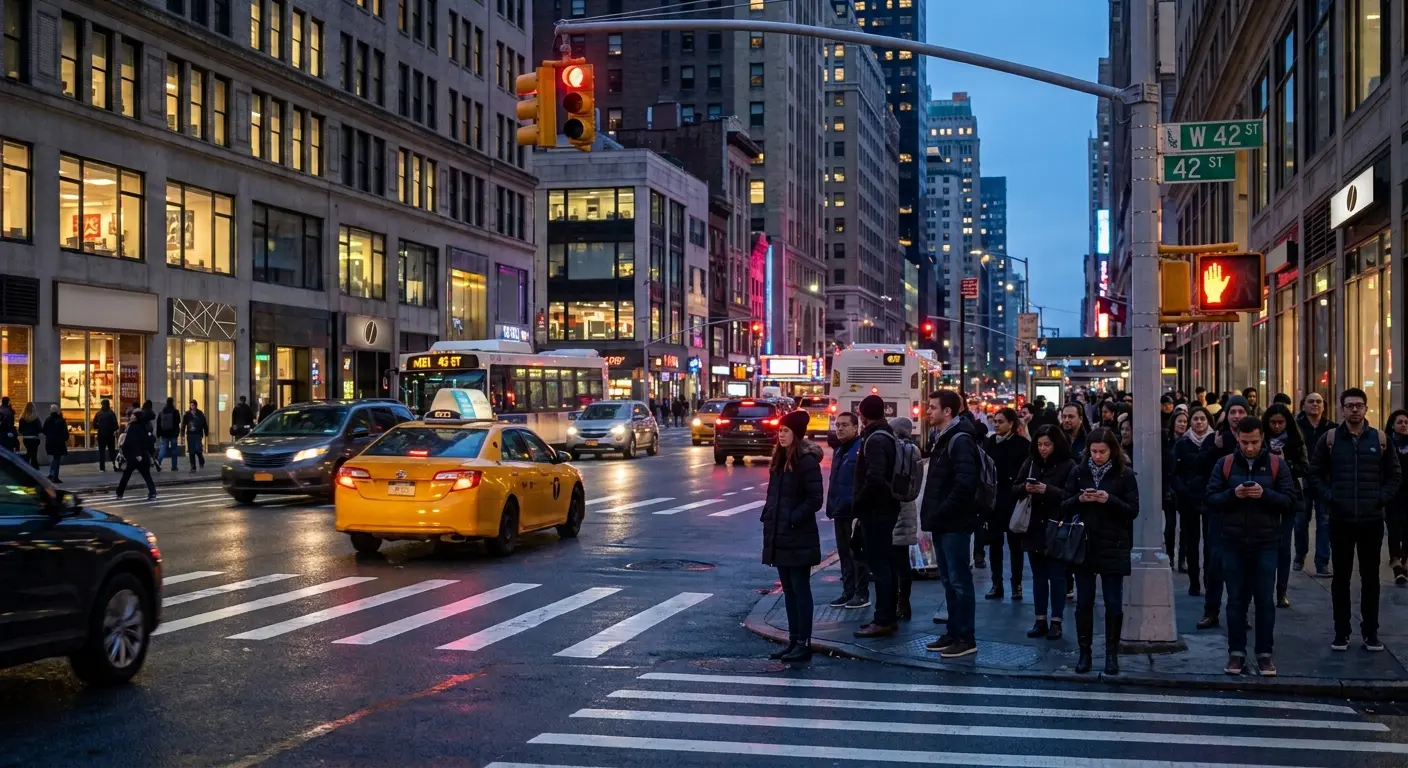
Pedestrian crashes after sunset are getting renewed attention in New York City as officials warn that fall evenings can create especially dangerous conditions for people on foot.
On October 29, 2026, the New York City Department of Transportation announced the return of its annual Dusk and Darkness campaign, a public safety effort focused on the risks pedestrians face during darker evening hours. The announcement came just before daylight saving time ended on November 1, when sunset began arriving earlier and more New Yorkers started commuting home in low-light conditions.
For a city built around walking, crossing the street is part of everyday life. But each faIl, the combination of earlier sunsets, busy intersections, and heavy vehicle traffic creates a period of heightened concern.
Why pedestrian crashes after sunset draw concern every fall
According to NYC DOT, the fall period surrounding the end of daylight saving time has long been associated with increased danger for pedestrians during evening hours. The the city’s campaign highlights a familiar pattern: as daylight fades earlier, more pedestrians and drivers share the road in reduced visibility.
That concern is not only about darkness itself. Evening traffic often includes turning vehicles, congestion, distracted driving, and fast-moving trips home from work. At busy intersections across Manhattan, Brooklyn, Queens, the Bronx, and Staten Island, those factors can overlap in ways that make crashes more likely.
The city’s broader Vision Zero safety efforts continue to focus on reducing traffic deaths and serious injuries, especially among pedestrians, who remain among the most vulnerable road users.
NYC says pedestrian fatalities are down, but the danger remains
There is encouraging news in the larger traffic-safety picture.
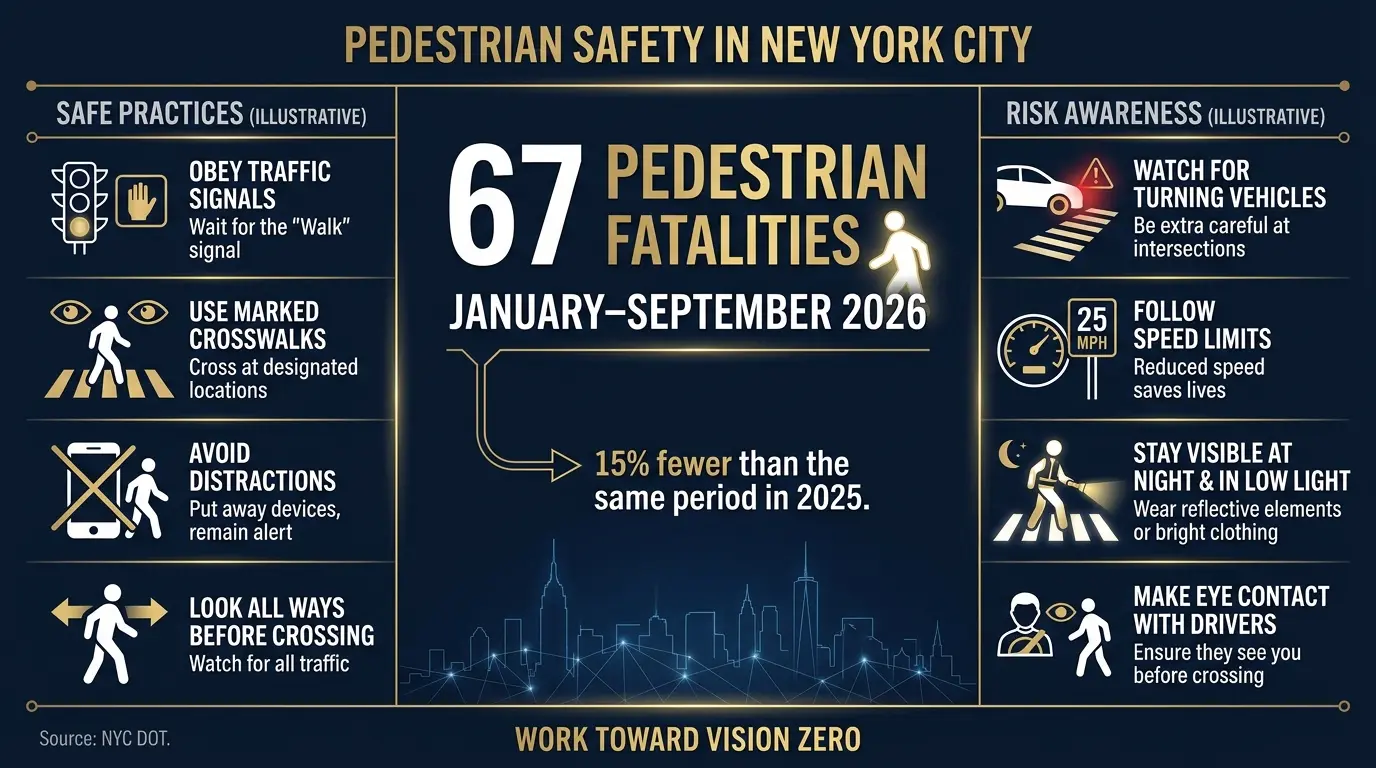
In an October 2026 announcement, NYC DOT reported that 67 pedestrians were killed in traffic crashes through September 30, 2026, a 15% decrease compared with the same period in 2025.
That decline matters. But it does not erase the risks that still exist during the darker months of the year.
Even with lower year-to-date fatality numbers, pedestrian crashes after sunset remain a serious public safety issue. A single collision can leave a pedestrian with life-changing injuries, including fractures, traumatic brain injuries, spinal damage, and other long-term medical complications.
The Dusk and Darkness campaign focuses on driver behavior
NYC’s Dusk and Darkness campaign is not just about reminding pedestrians to stay alert. It also places renewed focus on drivers and roadway conduct.
As part of the campaign, city officials announced increased NYPD traffic enforcement during late-afternoon, evening, and overnight hours. The emphasis includes behaviors often linked to pedestrian collisions, such as speeding, failing to yield, distracted driving, and ignoring traffic signals.
This focus reflects an important reality: pedestrian crashes after sunset are often examined in the context of visibility, driver attention, and roadway behavior, not darkness alone.
New York law also recognizes the responsibilities drivers have toward pedestrians. Under Vehicle and Traffic Law § 1146, motorists are required to exercise due care to avoid colliding with pedestrians. In addition, Vehicle and Traffic Law § 1151 addresses pedestrian right-of-way protections in crosswalk situations where traffic-control signals are absent or not operating.
When a pedestrian is struck, the legal review may involve whether a driver yielded properly, was traveling too fast for conditions, or failed to use reasonable care.
Pedestrian crashes after sunset can lead to major legal and financial consequences
For injured pedestrians, the impact of a crash often extends far beyond the scene itself.
Medical treatment may continue for months. Some victims are unable to work. Others face ongoing pain, rehabilitation, and major disruptions to daily life. In New York, pedestrians injured by motor vehicles are generally covered by the state’s no-fault insurance framework, as explained by the New York Department of Financial Services. Depending on the seriousness of the injuries and the circumstances of the collision, additional claims may also be reviewed.
These cases are often shaped by police findings, witness accounts, traffic conditions, and the actions of the driver involved. Poor visibility may be part of the context, but it does not automatically excuse negligent driving.
A seasonal warning with year-round legal importance
The Dusk and Darkness campaign is seasonal, but the legal questions raised by pedestrian crashes are relevant throughout the year.
When city agencies publicly warn about predictable risks during the evening commute, those warnings reinforce a broader point: pedestrian safety remains a major issue in New York City, especially at intersections where visibility and driver conduct can make all the difference.
Pedestrian crashes after sunset are not just traffic statistics. They are serious incidents that can alter a person’s health, livelihood, and future in an instant.
William Schwitzer & Associates advocates for injured pedestrians
At William Schwitzer & Associates, our attorneys represent people injured in pedestrian accidents throughout New York City.
Our firm advocates for individuals and families affected by serious vehicle collisions, including cases involving crosswalk crashes, failure to yield, and other dangerous driving conduct.
To discuss a pedestrian accident case, call William Schwitzer & Associates at (212) 683-3800.
Legal Disclaimer
Important:
This information is only a general guide and is NOT LEGAL ADVICE. Each case is different. The best option is to call our offices for specialized help, call (212) 683-3800 and contact William Schwitzer & Associates for legal assistance.
The images shown in this blog are for illustrative purposes only.