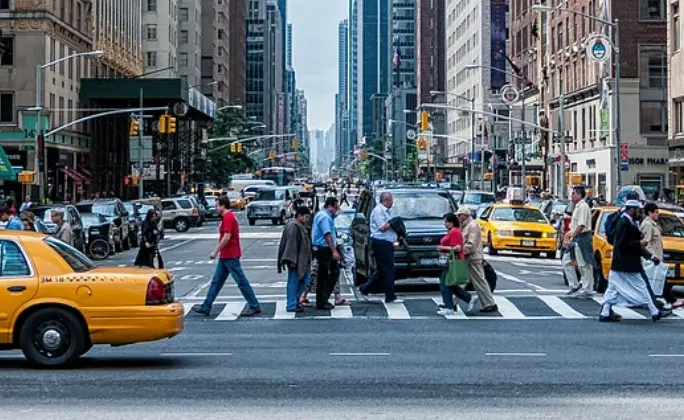
As Vision Zero continues to shape how New York City addresses safety, the latest figures are reason for cautious optimism. The results matter because they reflect the experiences of people living and traveling throughout New York City. Here’s what the new data tells us about NYC Pedestrian Accidents in 2025 and what’s still at stake for our safety.
1. Record-Low Traffic Fatalities, Pedestrians Included
In the first six months of 2025, traffic deaths across the city plummeted 32% compared to the same period last year. This historic drop reflects across-the-board reductions, encompassing pedestrian fatalities as well. So far, there have been 51 pedestrian deaths, down from 63 in 2024.
These numbers show significant progress. Yet every statistic reflects a human impact, underscoring why pedestrian safety remains a critical concern.
2. First Quarter Summary Reinforces a Safer Trend
The first quarter of 2025 already saw 41 traffic-related deaths,24 fewer than the same period in 2024, making it the second safest opening quarter on record. This strong start coincides with ongoing initiatives aimed at improving pedestrian safety.
3. Crashes Still Happen, Analysis Identifies Patterns
NYC DOT’s SIRTA program investigated over 675 serious injury and fatal crash sites during Q2 2025 alone. These investigations uncovered that 215 involved pedestrians, with 67% occurring at intersections and 25% at mid-block locations.
The data also shows pedestrians crossing with the signal comprised 29% of injury cases, while 14% were crossing at unmarked locations or without signals. These trends guide where DOT prioritizes interventions.
4. High-Risk Corridors and Systemic Improvements
Through Vision Zero’s borough-level Pedestrian Safety Action Plans, the city identifies priority corridors and intersections posing the greatest hazards. To date, DOT has completed more than 57 street improvement projects, installed 87 speed reducers, activated 247 leading pedestrian intervals, added 253 accessible pedestrian signals, and painted over 19 million feet of pavement safety markings. These efforts reflect systematic moves to make streets more forgiving.
5. Enforcement: Cracking Down on Dangerous Driving
Engineering improvements alone aren’t enough. Enforcement plays a crucial role. So far in Fiscal 2025, police issued 119,145 Vision Zero–related moving summonses, including 31,349 for speeding and 11,024 for failure to yield to pedestrians. These numbers underscore enforcement’s critical role in reducing pedestrian fatalities.
6. Camera Programs Deliver Real Results
Automation is working. Intersection red-light cameras have slashed red-light violations by 73% and T-bone crashes by 65%, though limitations remain; cameras cover only about 1% of signalized intersections, as state law restricts their placement. Vision Zero advocates are pushing for expansion.
7. NYC Pedestrian Accidents in 2025: Why It Still Matters
Despite improvements, pedestrians remain vulnerable. Many accidents happen mid-block or at intersections without clear signals or crossings. As improvements roll out, the the city continues to evolve its safety infrastructure, but no system is perfect.
WSAT Law does not provide street safety tips or advice. We stand with pedestrian accident survivors and families navigating loss. When circumstances raise questions about street design or policy decisions, we advocate for injured pedestrians and pursue legal accountability through the appropriate process.
Final Thought
Data shows a promising downward trend in NYC pedestrian accidents in 2025, thanks to street redesigns, enforcement, and planning. But the mission isn’t over. Behind each data point are individuals and families affected by these incidents. If you or someone you know was harmed in a pedestrian crash, WSAT Law is here to lend experience, advocacy, and care.
Important:
This information is only a general guide and is NOT LEGAL ADVICE. Each case is different. Images used are conceptual illustrations and do not depict actual events or clients. The best option is to call our offices for specialized help. Call (212) 683-3800 to contact William Schwitzer & Associates for legal assistance.