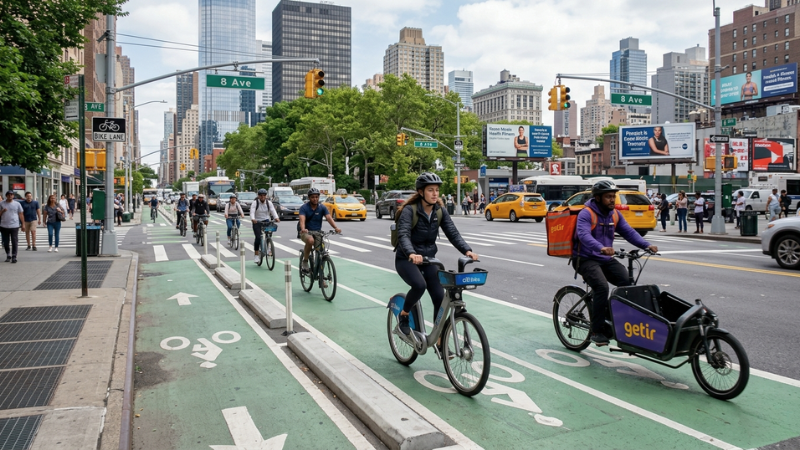
Every day, hundreds of thousands of New Yorkers travel through the city by bike. Now, a new public health study is taking a closer look at how those rides may connect to long-term cardiovascular health and street safety across the five boroughs.
The NYC E-Bike Health Study is a new collaboration between New York University and the New York City Department of Transportation. According to NYU, the research will examine how e-bike use and cycling infrastructure may influence physical activity and heart health among New Yorkers.
Researchers involved in the project stated that e-biking can provide moderate physical activity while also changing how people move around urban areas. The study is expected to evaluate how protected bike lanes, greenways, and transportation patterns may affect public health outcomes in New York City.
NYC E-Bike Health Study and Cycling Growth in New York
Cycling in New York City has expanded significantly in recent years. NYU reported that more than 600,000 cycling trips are now taken daily across the city, representing major growth over the past decade.
The increasing popularity of e-bikes has also brought renewed attention to how city streets are designed and reviewed. Delivery workers, commuters, and families are among the groups increasingly relying on electric bicycles for transportation throughout NYC.
According to the New York City Department of Transportation, the city has continued expanding protected bike lanes and micromobility infrastructure in an effort to support safer travel conditions for riders.
NYC Department of Transportation
Public agencies and researchers often examine whether transportation infrastructure affects not only traffic patterns, but also public health outcomes and roadway safety trends.

How Transportation and Public Health Are Commonly Reviewed
Transportation-related studies frequently focus on broader questions involving mobility, physical activity, environmental conditions, and injury prevention.
The Centers for Disease Control and Prevention has previously noted that physical activity can contribute to improved cardiovascular health and lower risks associated with sedentary lifestyles.
CDC Physical Activity Basics
At the same time, city transportation systems are also reviewed through a safety lens. Infrastructure projects involving bike lanes, traffic calming measures, and roadway redesigns are often analyzed by transportation agencies and researchers to better understand how different street layouts affect all road users.
The Federal Highway Administration has published research discussing how separated bike lanes and protected cycling infrastructure may influence rider behavior and roadway interactions.
Federal Highway Administration Bicycle Safety Resources
These reviews typically involve transportation planners, public health researchers, engineers, and local agencies studying long-term trends rather than isolated incidents.
NYC E-Bike Health Study May Influence Future Infrastructure Discussions
The new NYC E-Bike Health Study is expected to collect information about trip frequency, travel patterns, and rider activity levels. NYU also indicated that wearable-device research may later be included to evaluate cardiovascular effects associated with e-bike use.
In New York City, transportation planning discussions often involve balancing mobility, accessibility, congestion concerns, and roadway safety considerations. Public agencies may use research findings to help evaluate future infrastructure priorities and transportation initiatives.
The U.S. Environmental Protection Agency has also published findings connecting walking, biking, and e-biking to reduced emissions and transportation-related environmental impacts.
EPA Transportation and Air Quality Information
As e-bike usage continues expanding across dense urban areas like NYC, studies involving rider behavior and roadway infrastructure may remain an important part of broader public safety and transportation conversations.

Public Attention on E-Bike Safety Continues Across NYC
E-bikes have become increasingly visible throughout New York City streets, particularly among delivery workers and commuters navigating high-traffic areas.
At the the same time, conversations surrounding cycling safety, roadway design, and shared traffic environments continue drawing attention from city agencies and advocacy groups.
The National Highway Traffic Safety Administration notes that bicycle and micromobility safety reviews often examine factors such as visibility, roadway conditions, vehicle interactions, and infrastructure design.
NHTSA Bicycle Safety Information
When transportation-related incidents occur in New York, investigations may involve multiple agencies reviewing roadway conditions, traffic patterns, infrastructure design, and other contributing circumstances.
William Schwitzer & Associates represents individuals and families affected by serious traffic-related incidents throughout New York City. Our firm continues following developments involving roadway safety, transportation infrastructure, and public-interest investigations across NYC.
Important:
This information is only a general guide and is NOT LEGAL ADVICE. Each case is different. The best option is to call our offices for specialized help, call (212) 683-3800 and contact William Schwitzer & Associates for legal assistance.
The images shown in this blog are for illustrative purposes only.