Construction Workplace Fatalities 2024 are receiving renewed attention following the release of new federal data from the U.S. Bureau of Labor Statistics (BLS). On February 19, 2026, the agency published its latest findings on fatal occupational injuries, showing that although workplace fatalities declined nationwide in 2024, the construction industry continued to record the highest number of fatal work injuries among all private industries.
For New York City, where construction remains a major industry, the the newly released statistics provide additional context about national workplace fatality trends and construction employment risks.
Construction Continued to Record the Most Workplace Fatalities
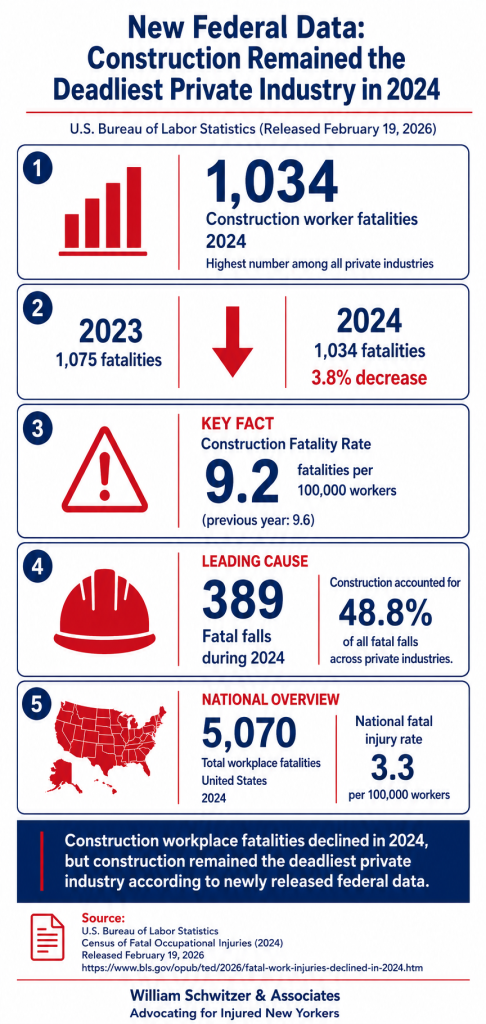
According to the U.S. Bureau of Labor Statistics, the private construction industry recorded 1,034 fatal work injuries in 2024, down from 1,075 fatalities in 2023, representing a 3.8% decrease.
Despite the decline, construction remained the deadliest private industry sector in the United States based on the total number of workplace fatalities.
The Bureau of Labor Statistics also reported that the construction industry’s fatal injury rate improved from 9.6 to 9.2 fatalities per 100,000 full-time equivalent workers, although it remained considerably higher than the national average.
The complete findings are available in the BLS Census of Fatal Occupational Injuries:
https://www.bls.gov/news.release/cfoi.nr0.htm
Additional industry data and tables are available here:
https://www.bls.gov/iif/fatal-injuries-tables.htm
Newly Released Federal Data Show Overall Improvement
The newly released BLS report found that 5,070 workers died from work-related injuries during 2024, compared with 5,283 fatalities in 2023, representing a 4.0% decrease nationwide.
The overall fatal work injury rate also declined from 3.5 to 3.3 fatalities per 100,000 full-time equivalent workers, marking the second consecutive annual decrease reported by the Bureau.
According to the Bureau of Labor Statistics, a worker died from a work-related injury approximately every 104 minutes in 2024, compared with every 99 minutes during the previous year.
The BLS also summarized these findings in The Economics Daily, highlighting the decline in fatal work injuries across several major industries while noting that construction continued to record the highest number of workplace fatalities.
Read the BLS summary:
https://www.bls.gov/opub/ted/2026/fatal-work-injuries-declined-in-2024.htm
Construction Continues to Stand Out Among Private Industries
The latest BLS data illustrate how construction compares with other major private industries.
Although fatalities declined across several sectors, construction remained at the top of the list, followed by transportation and warehousing, agriculture, forestry, fishing and hunting, and manufacturing.
The chart below, published by the U.S. Bureau of Labor Statistics, compares fatal work injuries by private industry sector in 2023 and 2024.

Image Source
U.S. Bureau of Labor Statistics
https://www.bls.gov/opub/ted/2026/fatal-work-injuries-declined-in-2024.htm
Falls Represented a Large Share of Fatal Construction Events
The Bureau of Labor Statistics also reported that falls, slips, and trips remained one of the leading causes of fatal work injuries in construction.
During 2024, the construction industry recorded 389 fatal falls, accounting for 48.8% of all fatal falls across private industry.
While the number declined compared with 2023, the data continue to show that fall-related incidents remain an important part of broader occupational injury trends.
Additional fatal event data are available from the Bureau of Labor Statistics:
https://www.bls.gov/news.release/cfoi.nr0.htm
Why These Statistics Matter
The Census of Fatal Occupational Injuries is one of the nation’s most comprehensive sources of workplace fatality data.
According to the Bureau of Labor Statistics, the Census uses information gathered from multiple federal, state, and independent sources to verify each fatal workplace injury before it is included in the annual report.
Rather than focusing on individual incidents, these statistics help identify long-term occupational injury trends across industries and occupations.
Learn more about the Census of Fatal Occupational Injuries:
How Serious Construction Incidents Are Typically Reviewed
When a serious workplace injury or fatality occurs, several agencies may review the circumstances surrounding the incident.
Depending on the facts involved, those reviews may include workplace inspections, employer records, witness information, and other available documentation. Each review is based on the specific circumstances of the incident, and different agencies may have different responsibilities during that process.
More information about OSHA inspections is available here:
https://www.osha.gov/inspections
Information about OSHA fatality inspections can be found here:
https://www.osha.gov/fatalities
Construction Workplace Fatalities 2024 Continue to Highlight Workplace Safety
Although newly released federal data show that workplace fatalities declined overall in 2024, construction continued to record more fatal work injuries than any other private industry.
For New York City, where construction activity continues throughout the five boroughs, these statistics provide valuable context for understanding occupational injury trends and the continued importance of workplace safety across the industry.
William Schwitzer & Associates does not oversee workplace safety programs or investigate construction sites. Our role is to advocate for construction workers and families affected by serious workplace injuries throughout New York City.
Important:
This information is only a general guide and is NOT LEGAL ADVICE. Each case is different. The best option is to call our offices for specialized help, call (212) 683-3800 and contact William Schwitzer & Associates for legal assistance.
The images shown in this blog are for illustrative purposes only.