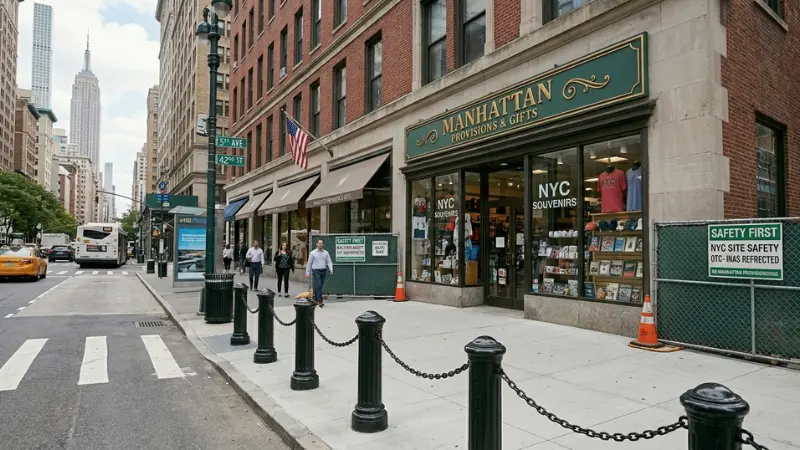
A vehicle leaving the roadway and entering a sidewalk space is something most people never expect to see.
Reports of an SUV crashing into a NYC storefront bring attention to how quickly everyday city environments can change. Incidents like this, as reported in Manhattan, may involve more than just a single moment. They often lead to broader review processes focused on street safety, pedestrian protection, and how urban risks are managed.
While early details indicated no pedestrians were struck in this case, the situation reflects a type of incident that continues to raise concerns across New York City.
When an SUV Crashes Into NYC Storefront Areas
The phrase SUV crashes into NYC storefront highlights a category of incidents that transportation and safety agencies monitor closely.
In dense areas like Manhattan, sidewalks, storefronts, and traffic lanes exist within very tight spaces. When a vehicle crosses that boundary, even briefly, the the potential for harm becomes significant.
According to the National Highway Traffic Safety Administration, pedestrian-related crashes remain a major safety concern, particularly in urban environments.
https://www.nhtsa.gov/road-safety/pedestrian-safety
New York City agencies, including the New York City Department of Transportation, track traffic patterns and street design to better understand how and why these incidents occur.
https://www.nyc.gov/content/visionzero/pages/
How These Incidents Are Typically Reviewed
When an SUV crashes into NYC storefront locations, multiple layers of review often follow.
These reviews are not limited to the driver alone. They may involve:
- Vehicle operation factors
- Roadway design and curb placement
- Traffic flow and congestion patterns
- Physical barriers between streets and pedestrian areas
Agencies often examine whether the environment itself contributed to the outcome. This can include how sidewalks are protected and whether safeguards were in place.
The Federal Highway Administration studies roadway design and how infrastructure impacts crash outcomes, including incidents involving pedestrians and roadside structures.
https://highways.dot.gov/safety
The Role of Street Design and Urban Density
In New York City, street design plays a major role in how incidents unfold.
Busy intersections, outdoor dining setups, delivery traffic, and pedestrian movement all exist in close proximity. When a vehicle loses control, there is often very little space to absorb the impact.
That is why safety measures such as barriers, bollards, and curb protections are frequently part of city planning discussions. The New York City Department of Buildings may also become involved when a structure is impacted, reviewing damage and structural safety.
https://www.nyc.gov/site/buildings/index.page
These overlapping responsibilities reflect how multiple systems are involved whenever a crash extends beyond the roadway.
Why Storefront Crashes Draw Public Attention
When an SUV crashes into NYC storefront, it often draws attention because it affects spaces people see as safe.
Sidewalks, shops, and outdoor seating areas are part of everyday life. When a vehicle enters that space, it raises broader questions about:
- How protected pedestrian areas are
- Whether safeguards functioned as intended
- How similar incidents are prevented in dense environments
Public attention does not focus only on the event itself. It often shifts toward how safety systems respond and whether changes are considered afterward.
A Broader Look at Urban Safety and Accountability
Incidents like an SUV crashes into NYC storefront are typically examined within a larger framework of accountability.
This includes reviewing:
- Traffic safety policies
- Enforcement of driving regulations
- Infrastructure planning and updates
- Responsibilities across multiple parties
In many cases, these reviews contribute to ongoing conversations about how city streets are managed and how risks are reduced over time.
Conclusion
An SUV crashes into NYC storefront is not just an isolated event. It reflects how closely connected vehicles, pedestrians, and city infrastructure are in places like New York.
These incidents are often followed by detailed reviews that look at both individual factors and broader safety systems. As Building Safety Month approaches, situations like this highlight how public safety discussions extend beyond construction sites and into everyday city life.
At William Schwitzer & Associates, P.C., these matters are part of a larger effort to understand how incidents are reviewed and how individuals affected by them are represented within that process.
Important:
This information is only a general guide and is NOT LEGAL ADVICE. Each case is different. The best option is to call our offices for specialized help, call (212) 683-3800, and contact William Schwitzer & Associates for legal assistance.
The images shown in this blog are for illustrative purposes only.