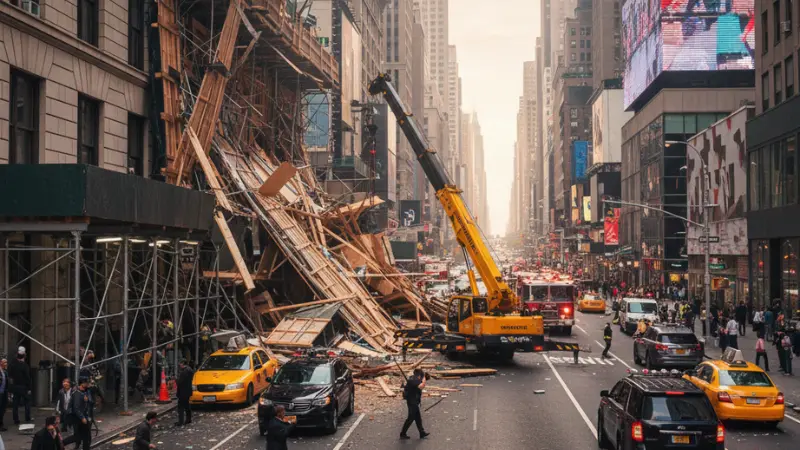
A Spyder Crane Crash in Midtown has drawn public attention to the risks associated with crane operations on dense urban construction sites. While no injuries were reported, incidents involving heavy equipment in high-traffic areas often prompt regulatory review and public-interest scrutiny due to the potential impact on workers and pedestrians.
Construction projects in Manhattan frequently operate in close proximity to sidewalks, roadways, and neighboring buildings, increasing the importance of coordination, permitting, and oversight.
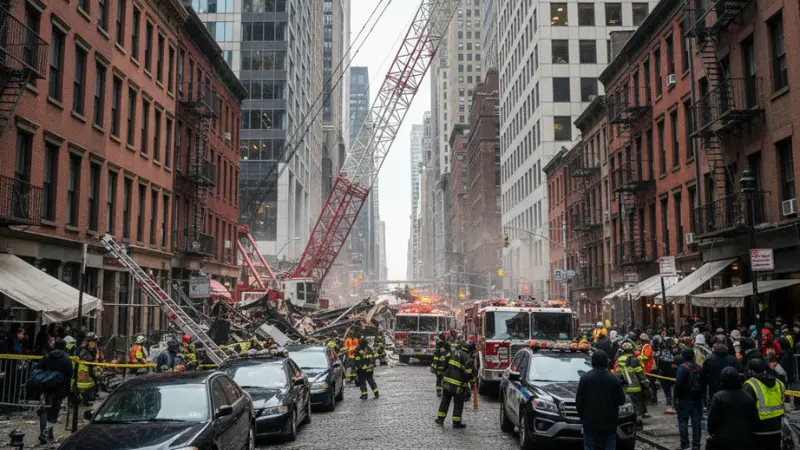
Afortunadamente, nadie resultó herido en este accidente, pero el riesgo de catástrofe era real.
Spyder Crane Crash in Midtown and Construction Incident Data
City agencies track construction-related incidents across New York to identify trends and areas of concern. According to data published by the New York City Department of Buildings (DOB), hundreds of construction-related incidents are reported annually, including events involving cranes, hoisting equipment, and scaffolding.
These reports are used to inform enforcement actions and safety reviews, particularly on projects involving elevated work and heavy machinery.
Source – NYC Department of Buildings (Construction Incident Data):
https://www.nyc.gov/site/buildings/safety/safety.page
¿Quiere saber más sobre la seguridad en las obras de construcción en Nueva York? Lea más en nuestra página: Ley de andamios
How Crane Incidents Are Reviewed in New York City
When a Spyder Crane Crash in Midtown or similar equipment incident occurs, regulatory agencies typically conduct a formal review. These reviews focus on documenting site conditions at the time of the incident, including permitting status, equipment placement, and compliance with applicable building and safety codes.
The purpose of these reviews is to establish a factual record. They do not presume fault and operate independently from any civil legal process that may follow.
Urban Construction Risks and Public Interest
Crane and scaffolding incidents raise broader public-interest questions because of their potential impact beyond the worksite itself. In high-density areas such as Midtown Manhattan, construction activity often occurs near active sidewalks and traffic corridors.
The Occupational Safety and Health Administration (OSHA) identifies crane and hoisting operations as high-risk activities within the construction industry, particularly in urban environments where space constraints increase operational complexity.
Source – OSHA Construction Industry Overview:
https://www.osha.gov/laws-regs/regulations/standardnumber/1926
Legal Context Following Construction Equipment Incidents
While regulatory agencies address compliance and enforcement, civil legal processes serve a separate function. These processes provide a framework for examining responsibility and addressing the impact of construction-related incidents on workers and the public.
A Spyder Crane Crash in Midtown, even when no injuries are reported, may still become part of a broader legal and regulatory review depending on the circumstances documented by authorities.
Advocacy for Those Affected by Construction Accidents
At William Schwitzer & Associates, our role is to advocate for construction workers and pedestrians who suffer physical injuries due to unsafe construction conditions or negligence. We do not investigate incidents, report the news, or enforce safety regulations. Our work focuses on representing injured individuals and families within the legal system after serious construction-related accidents.
Understanding how construction incidents are reviewed helps place these events in a broader legal and public-interest context.
Importante:
This information is only a general guide and is NOT LEGAL ADVICE. Each case is different. Images used are conceptual illustrations. The best option is to call our offices for specialized help. Call (212) 683-3800 to contact William Schwitzer & Associates for legal assistance.